Friday, 18 August 2017

GWR Large Prairies: First colour pictures

Today we have our first colour pictures of the Large Prairies in game.

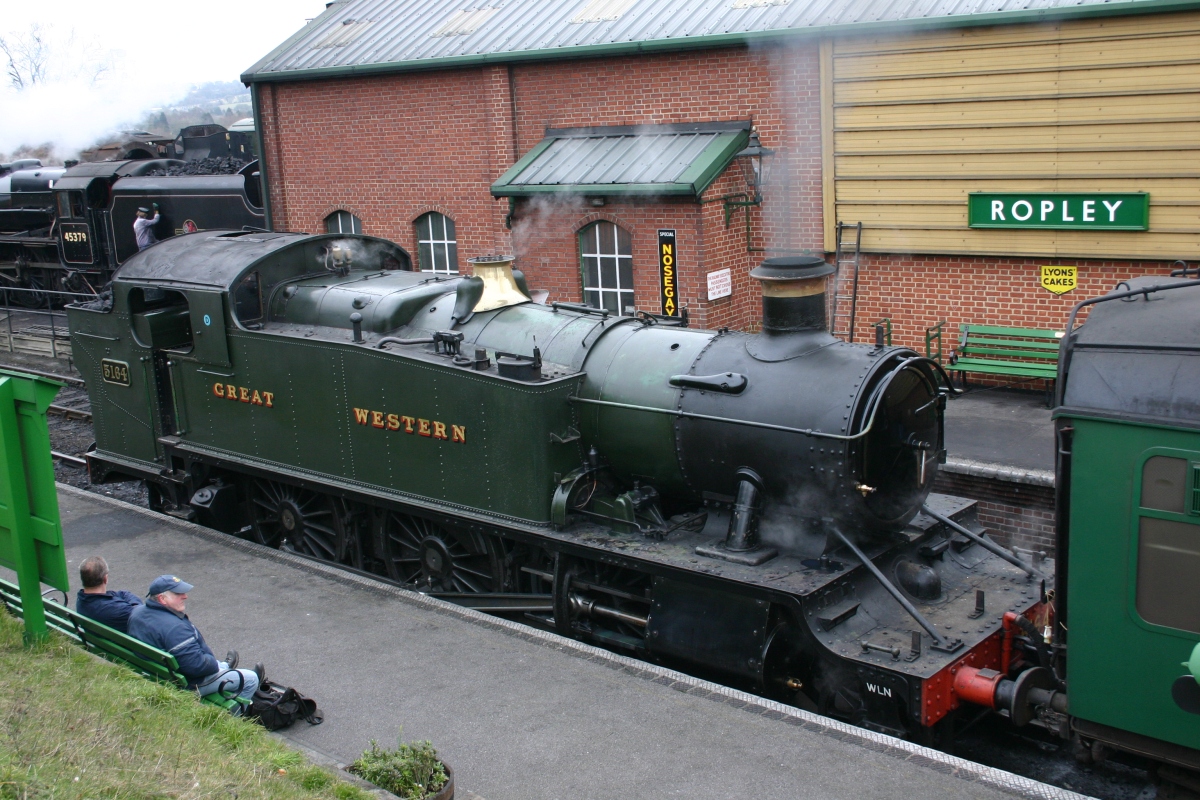
Starting off with the 5100 class, shown here with the pre-1934 lettering.
Please note that all liveries are available on all engines as appropriate.


This shows the original design of the 5100 class which started construction in 1903 - they actually began life as the 3100 class but were renumbered in 1927 (you can also renumber any engine to this in game if you wish to). The square frames are clearly evident as is the lack of outside steam pipes, although these can be added as an option. 40 of these were built.

Next we have the 5101 class which were built from 1929 right up to 1949 and covered 140 engines, 5101-5110, 5150-5199 and 4100-4179.


Seen here in the 1934-42 shirt button livery the changes to the front end are very clear with the new curved frames and the external steam pipes.

Another variation of the large prairies is the 6100, 70 engines built 1931-35 and with an increased boiler pressure from 200psi to 225psi specifically for commuter services in London which they worked right up to the 1960's.


It is shown here in the 1942-48 livery. They were usually referred to by trainspotters as 'Tanner One-ers'. This being in reference to the 61xx numbering using slang for a sixpence and a penny.

Finally we have the 8100 class, just 10 engines converted from 5100's during 1938/9. These also had the boiler pressure increased to 225psi and had smaller driving wheels at 5' 6" (instead of 5' 8") and smaller pony truck wheels at 3' (instead of 3' 8").


Altered to give a supposed better acceleration they were mixed in with the 6100 class and performed the same duties.
In these pictures it is wearing the short lived livery which consisted of the GWR style lettering but using the newly formed British Railways name.

Although all of the engines shown are correct for each period we are aware that lots of you like the familiar preservation appearance of these engines and also like to recreate the activities of those cheeky GWR shed crews who ignored the rules about painting the chimneys and safety valve bonnets of non-express engines and polished them anyway!
So using the standard scenario numbering system you can have your chimney and safety valve bonnet shining with much less scraping and polishing. And this is of course available on all classes.


So that covers the 4 classes included in the pack and takes us right up to 1948. Next time we'll take a look at the large prairies as they appeared under British Railways and worked through right to the very last days of steam in Britain.

Friday, 4 August 2017

GWR Large Prairies: Work In Progress, Cab

This week we take a look at the cab of the Large Prairies. Although very similar to the 5200 class they still have enough differences that it required a full build rather than a copy and paste and we also took the opportunity to improve the details of a majority of the controls.

We've been very fortunate to have the input of one of the footplate crew of 5199 so we have been able to make sure that every tap and lever turns the exact right amount and in the correct direction, a detail that's not always easy to find out.


We've also been really lucky to have help from another footplate crew member (this time of 9466, amongst others) and between the two of them we now have an all new brake simulation for Advanced Mode that adds even more to the realistic experience we offer to you in Victory Works products.


To explain how it works, the following is taken from the upcoming Large Prairies manual:

The vacuum brake is used to pull the brake shoes away from the wheels by creating a vacuum in the pipes connected to them. The brake has 3 settings, brake off which forces a vacuum into the pipes and takes the brakes off, brake on which lets air into the pipes and applies the brakes, and brake running which holds the vacuum steady at its current pressure.
The brake pressure gauge shows the current pressure in the system, from 0” (on) to 25” (off).
In basic mode all of this can be controlled by the brake lever.

Keys: ‘ (apostrophe), ; (semicolon)


Advanced Mode

In Advanced mode the GWR large prairies require the use of the Large Ejector to release the brake, the brake lever being used to apply it. You will also need to be aware of the brake reservoir which is now accurately simulated.

Important: Note that in Advanced mode the F4/F5 HUD brake pressure may NOT be representative of the engines brake gauges and you should use the gauges in the cab to operate the engine correctly. Please also note that the setting of the lamp head codes is now CRITICAL to the operation of the brakes so that the engine knows how much of the train is made up of fitted (vacuum braked) rolling stock.

Vacuum brakes operate by having a pressure difference between a “train pipe” and a “reservoir”. When the train pipe is less than the reservoir then the difference between these pressures is how hard the brakes are applied. The brakes are fully released with a difference of approximately 22” or more, and fully applied with a difference of approximately 5” or less.

However these systems are not airtight and therefore when leaks occur the train pipe and the reservoir (although leaking much slower than the train pipe) will trend towards 0”. The way create to create a vacuum in both systems on the prairies is to use the large ejector which will create a vacuum in the train pipe, and once the train pipe pressure reaches the same as the reservoir then an automatic valve will open and the reservoir pressure will increase as well.

The large ejector is steam powered and requires a pressure of at least 90 psi in the boiler so be careful to manage this properly or you may not be able to release the brakes.

Keys: Large Ejector - P, Shift P

In addition to the large ejector (which is steam driven) the large prairies also have a mechanical vacuum pump (powered by a piston) which will start to work when the locomotive is travelling at approximately 10 mph and will apply pressure to the train pipe to counter any leaks. The pump can hold the vacuum up to 25” and on a short train can even create vacuum in the train pipe up to 22” or 23”. This creates the effect of slowly releasing the brakes when you are braking at speed and you may need to use multiple applications of the brake lever to stop the train.

To this point we have referred to the train pipe as it applies to the engine, however on a fitted train (where some or all of the rolling stock is fitted with vacuum brakes) this pipe is shared along the whole train via flexible connecting pipes. This means that the ejector and pump are creating vacuum along the whole length of the train and so this will increase the time that it takes to create or release pressure from the train pipe. In addition fitted stock have their own reservoirs so even if the train pipe is at 0” and engine reservoir falls to 0” (no pressure difference and therefore no brake application on the engine) the train will still be held by the brakes on the rest of the fitted stock. When running light or on a totally unfitted train you do not have this “backup” and it is advisable to apply the handbrake when stopping for any length of time as the train and pipe reservoir will slowly drain to 0”, releasing the engine brakes.

In Train Simulator there is no way for the engine to know what stock it is pulling so the prairies use the player selected head code to indicate how much of the train is vacuum fitted.

The head codes and percentages are as follows and on changing lamps (see section on head code setting below) you will see a message describing the code and how much of the train is fitted with vacuum brakes.
A: Express passenger 100%
B: Stopping passenger 100%
C: Parcels, perishables, etc. 100%
D: Express freight 100%
E: Express freight 50%
F: Express freight 0%
G: Light Engine 100% (can have 1 or 2 brake vans which would be fitted)
H: Through freight or Ballast 0%
J: Through mineral or Empty 0%
K: Pick up/Branch freight 0%

So if you are pulling a passenger train (using head code A for example) then the brake simulation will use 100% of the length of the train to calculate how long it takes to gain and lose pressure in the train pipe.

Finally, although not required for standard operation you can manually release pressure from the brake reservoir using the Reservoir Drain Valve next to the driver’s front window.


Although this may seem daunting to begin with it soon becomes second nature and we found it really added to the immersion of driving these large tank engines and it will enable you to pull away and stop in a much more realistic fashion than with the default in-game braking system.


Next week we'll be back with some in-game pictures of all the engine classes. So that's the 5100, 5101, 6100 and 8100, all of which will be included in the upcoming Large Prairies pack.

Friday, 21 July 2017

GWR Large Prairies: Work In Progress Update 2

Just a quick update today with some more pictures of the Large Prairie modelling.


We will have some pictures of the cab next week and thanks to some excellent help from two GWR engine footplate crew we will also talk a bit about the all new detailed brake simulation that's coming to Advanced mode.

Monday, 10 July 2017

GWR Large Prairies: First Pictures

Firstly our apologies that this wasn't posted on Friday as we had intended but we'd forgotten we were going to the Mid Hants Railway Summer Gala! Despite being ridiculously hot it was excellent with a great display of Southern steam and we had a fascinating tour of the works.

Anyway, enough of the SR, off to the GWR...

Below are the first work in progress renders of the Large Prairie model - this is the curved frame version that can be used for the 5101, 6100 and 8100 classes but we'll also be making the earlier 3100 (later renumbered 5100) class with the square frame.

As always we start with the wheels. These are 5'8" but we'll also need 5'6" versions for the 8100 class. The 8100 also has much smaller pony truck wheels - 3' instead of 3'8" which gives it a rather odd appearance at the rear.


The body starts to take shape.


Then we begin to add some details such as pipes, sanders and the smokebox door.


The wheel rods are put in place (and carefully animated!), the curved frame version of the boiler support is added and a chimney on the top and it starts to look like it might eventually go somewhere.


Finally for today more details are added including the roof being put in place


Thursday, 22 June 2017

Steam Summer Sale 2017

The Steam Summer Sale has just started and goes on until 5th July. Pick yourself up some great deals with up to 50% off of our Steam add-ons.


Click this link to see all of our DLC on Steam or click on an image below to view a particular DLC.

GWR Saint Class & Travelling Post Office - 40% off


BR Saint & TPO Livery Pack - 50% off (Note: Requires the GWR Saint & TPO add-on)


USATC S160 - 30% off


GWR 14xx - 30% off


LNER Peppercorn K1 - 30% off


GWR Small Prairies - 30% off


GWR 56xx - 30% off


GT3 Gas Turbine Prototype - 30% off


GWR Steam Railmotor - 30% off


Southern Bulleid Q1 - 50% off

Friday, 16 June 2017

The Year Ahead

It's that time again, the time when we announce our plans for the coming year(ish).

We have a bit of a sad announcement first which is that we have had to abandon the building of the LNER J21. We simply couldn't get hold of enough high quality plans, diagrams and reference material to do it justice. It's still high on our "want to do list" but for now we've had to put it to one side.

So with that out of the way, the better news is that our next loco will be..
Quite a few locos! Following on from the success of our GWR Small Prairies our next pack is going to be the GWR Large Prairies.


It will include all members of the following classes in GWR and BR liveries:
3100 (original numbering of the 5100 class), 5100, 5101, 6100, 8100.
Along with a selection of freight rolling stock to be announced (but if you have any requests, now is the time to say!) and including our unique whistle controlled "Active Guard" brake vans which were first released with the 4200/5200 and 7200 packs
We're also excited to announce that we've been experimenting with some new texturing techniques which we hope will add even more realism to the high quality models that we produce.


Following the Large Prairies we will be going north (home of our highly regarded K1) to an engine that we do have research for... the NER Class T2/LNER Q6.


After this we will be building on the success of our 4-6-0 GWR Saint with the GWR 1000 County class.


We hope these are locos that you are excited about seeing in Train Simulator and we'd like to take the opportunity to thank everyone who has purchased any of our engines and allowed us to continue doing what we love.

Friday, 2 June 2017

LB&SCR A1/A1X Terriers: Later Years Pack, Livery 5

And here we are at the final livery for the "Later Years" pack. This pack is currently in the hands of Steam Sounds Supreme and will be available once they have issued the patches for the Main and Early Years packs.

In 1960 the first steam engine in the new preservation movement was a certain well known Terrier which ran in the livery seen below. This livery was seen again in 2010 when it was repainted for the 50th Anniversary and has been requested by many people.

As with ALL of our named locos you can type ANY name you want to in the scenario editor and it will appear on the engine. So let's not have any silly comments asking the obvious question ;-)


Due to their long lives and being owned by so many different railways there were dozens of Terrier liveries and I'm sure we have disappointed some people by not creating them all but realistically we hope we've hit the majority of those that people asked for and that each of the packs has continued to provide the great value that we strive for here at Victory Works.

We also can't keep making Terrier's forever! So... what's next? All will be revealed next week.